
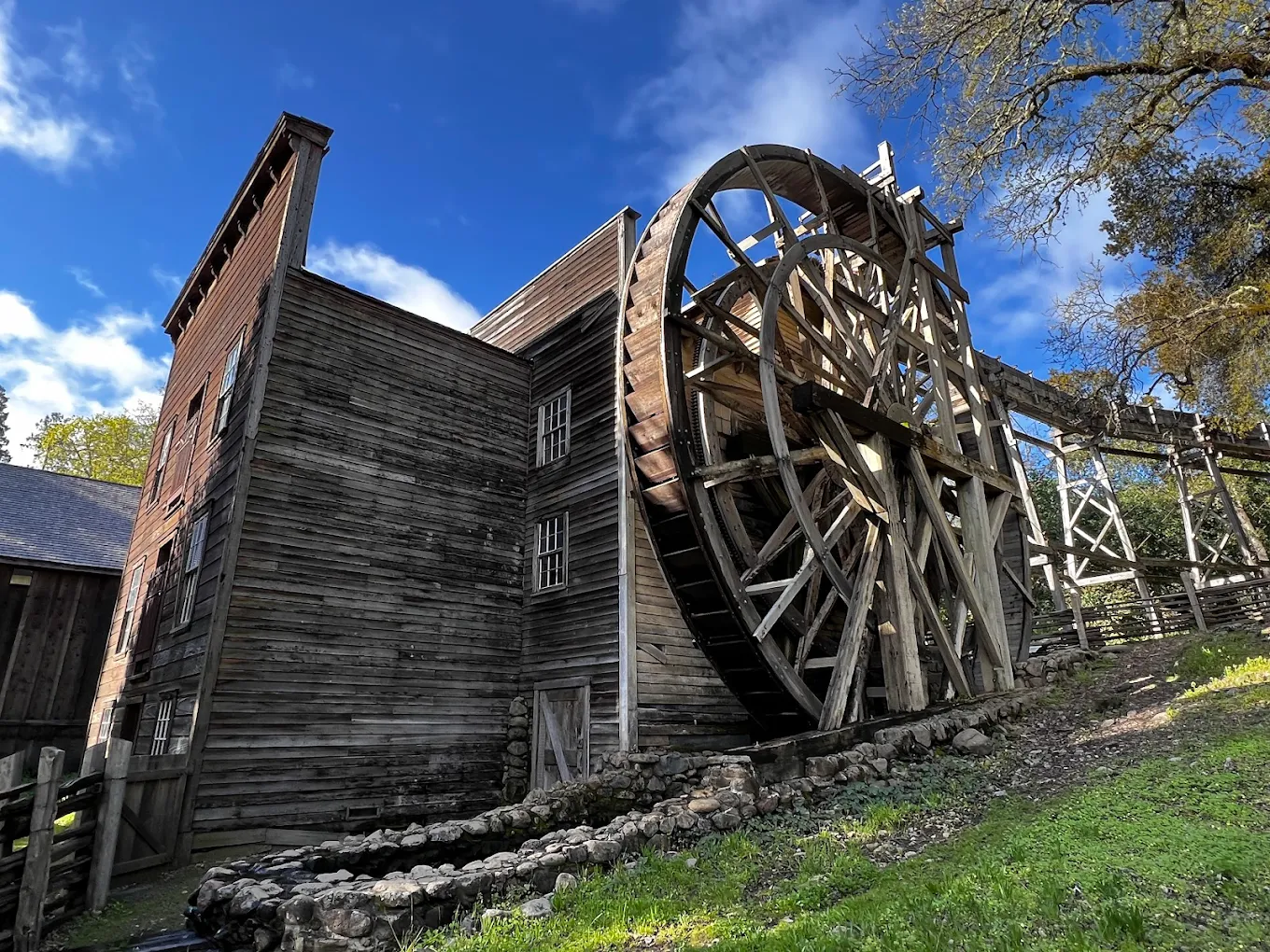
Long before the wineries arrived, grain was the backbone of Napa Valley life. The Bale Grist Mill, built in 1846 by Dr. Edward Turner Bale, was the first and for years the only mill in the region — a gathering place where settlers brought their wheat and corn and left with flour, gossip, and a sense of shared purpose. Also, according to at least one unverified account, a tremendous number of raccoons.
The mill sat at the edge of Bale’s sprawling Mexican land grant, powered by a creek that still runs today. Its massive wooden water wheel — over 36 feet in diameter — became one of the most recognizable landmarks in the upper valley. It was also, by several accounts, absolutely terrifying to small children, who believed it was alive and had opinions. One settler’s journal from 1853 records that his youngest son refused to approach the mill without “a stout stick and a prayer.”
Dr. Bale himself was a colorful figure — an Englishman who had somehow ended up with a Mexican land grant, a medical degree of questionable origin, and a reputation for getting into arguments at public gatherings. He once challenged a neighbor to a duel over the proper way to store barley, a dispute that was eventually settled not by pistols but by a third party who pointed out that neither man actually grew barley.
The mill’s daily operations were more practical than dramatic, though not without incident. Farmers arrived at dawn with cartloads of grain, waited their turn, and departed with freshly ground flour — unless the creek was running low, in which case everyone sat around and complained about the weather, a Napa Valley tradition that predates the wine industry by a comfortable margin.
As the valley’s economy shifted toward viticulture in the late 1800s, the mill gradually fell silent. Grapes, it turned out, did not require grinding, which put the mill at something of a professional disadvantage. The building endured, though, and in 1974 it was designated a California Historical Landmark — a recognition that surprised no one except possibly the raccoons, who had by then established a multi-generational presence in the rafters.
Today, Bale Grist Mill State Historic Park preserves what remains, and on certain weekends volunteers fire up the old wheel to demonstrate the milling process. The flour produced during these demonstrations is said to be excellent, though visitors are advised to purchase it quickly before the gift shop runs out. It always runs out. The flour has a following.
The St. Helena Historical Society continues to document the mill’s role in the story of our town. Our collection includes photographs, hand-drawn maps of the original grant, and one deeply confusing receipt for “twelve bushels of corn and a hat.” We do not know whose hat. We are open to theories.
Leave a Reply